Pages

Monday, March 21, 2016

How to be the kind of tourist tour guides love

© Istockphoto People ride past the Eiffel Tower in Paris during a bike tour of the city.


The kind of tourist you are determines the kind of tour you get, but unfortunately, I have learned, sometimes good people are bad tourists.

In my two-and-a-half years leading bicycle tours of Paris, I’ve met them all: the social-media addict who takes selfies in the middle of traffic, the whiny cyclist who complains about the hills; the happy-go-lucky adventurer who takes off on her own and immediately gets lost.

Here are a few simple tips about how to avoid common mistakes on group tours, and be the kind of tourist that tour guides love.

Engage

Unlike at the theater, there is no fourth wall in tour guiding, and your guide will watch you just as attentively as you watch him or her. Guides who sense that their group is uninterested will quickly go into autopilot, downgrading the experience for everybody. So get involved. Answer their questions, laugh at their corny jokes and stand close so they don’t have to strain their voices.

“A tour is a dialogue between you and the guide. An interactive tour is a fun tour,” says Stephanie Paul, tour guide and specialist on Franco-Jewish history. “Put your phone away . . . look, listen and enjoy interaction with a real human being.”

Be prepared

Sometimes there truly is nowhere to buy water, a sweater or gloves once the tour has begun. Come prepared, dress appropriately and don’t expect your guide to “Mary Poppins” extra supplies out of thin air. If you don’t know what to wear or bring, ask — before the day of the tour. Should you find yourself woefully underprepared, try to bear it graciously.

Paris guide Ellen Quinn-Banville sees plenty of underprepared tourists in her job. “I know you want to wear your best outfit because it’s Paris but, like, you will be freezing — and can you walk in those shoes?”

One person in a T-shirt complaining about being cold when the season calls for a parka puts unfair pressure on the guide and spoils the mood for everybody else.

Source by: http://www.msn.com/en-us/travel/tips/how-to-be-the-kind-of-tourist-tour-guides-love/ar-BBqIUCS

Sunday, March 20, 2016

Road Trip: Must-See Ghost Towns of Colorado

In Crystal, Colorado — Photo courtesy of Flickr user Misty Faucheux

One century’s gold is another one’s ghosts.

Gold rush fever marked many of Colorado’s mountain towns in the late 19th century, but eventually faded to dust - and took the residents with it.

Today, visitors can take a fascinating time-traveling tour through Colorado’s past, sometimes with a dash of spookiness, in these abandoned mining towns.

Even some of Colorado’s most popular tourist towns, like Breckenridge, Idaho Springs and Leadville, are former hot spots of mining action, except they managed to stay alive (or even thrive) after the crash.

Other ghost towns are completely abandoned, peppered by rickety, falling structures marking saloons, houses and shops. And others yet remain slightly inhabited, not fully dead, yet not exactly lively either, where residents today coexist with the ghosts of yesterday.

Colorado has more ghost towns than you could ever see, so choose carefully and see the best. Here are our favorite 10 ghost towns in Colorado, roughly zig-zagging from north to south.

Pro tip: This road trip is best in the warmer months, as many of these remote towns get completely snowbound at the first snowfall. 

Source by: http://www.10best.com/interests/travel-features/road-trip-must-see-ghost-towns-of-colorado/

A Dark Sky Park: Stargazing in Death Valley

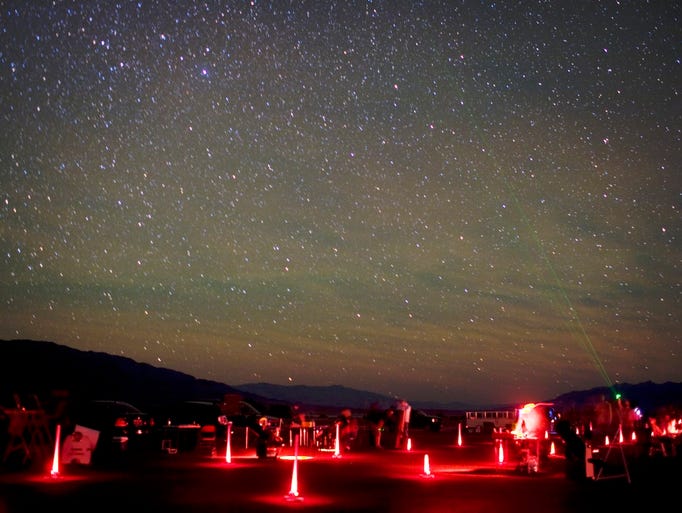
When the sun sets over Death Valley National Park, the world's largest International Dark Sky Park begins to shine.  William L. Castleman/Furnace Creek Resort


High-powered telescopes are at the ready for ample stargazing during the Death Valley Star Party, put on by Furnace Creek Resort and the park. Furnace Creek Resort

Under the darkness of night, gazing up at the seemingly millions of stars twinkling overhead, we couldn't help but pull out our smartphones and launch our star gazing apps. Scanning the sky, constellations were easily apparent and planets popped onto the screens. For those of us who live in or near cities across the USA, star gazing of this magnitude just doesn't happen.

When the sun sets over Death Valley National Park in the California and Nevada desert, about two hours west of Las Vegas, the world's largest International Dark Sky Park begins to shine. And with an area encompassing more than three million acres and exceedingly clear skies (rain is very rare here – just over two inches a year, on average), it's no surprise that the park has received that designation and is a popular destination for night-sky tourism, which is on the rise.

"Death Valley is a place to gaze in awe at the expanse of the Milky Way, follow a lunar eclipse, track a meteor shower, or simply reflect on your place in the universe," said National Park Service Director Jonathan B. Jarvis.

To help visitors do just that, the park and Furnace Creek Resort are hosting the Death Valley Star Party February 20 – 21. Over the course of the two days, amateur and seasoned astronomers are invited to join park rangers and the Las Vegas Astronomical Society on the resort's golf course, where telescopes of various sizes will be set up to gaze upwards. Expected to be in full display are Jupiter, Comet Lovejoy, Andromeda Galaxy, Orion Nebula and myriad other star clusters, galaxies and nebulae.

An event schedule for the two days also includes presentations and a laser-guided tour of the night sky featuring naked-eye visible objects (no telescope required!). Daytime viewing will be available, too, on Saturday, for a different perspective. A full schedule will be available at the park's visitors' center.

For "Star Wars" fans, there's a totally different way to see "Stars" in Death Valley. Several scenes of the original trilogy were filmed within the park, at easily-accessible sites such as Dante's View, Mesquite Flat Sand Dunes, Desolation Canyon, Artist's Drive and Golden Canyon, to name a few.

Death Valley National Park and Furnace Creek Resort host a number of other stargazing events throughout the year, though mostly between November and April, when temperatures are lower.

Can't make it to Death Valley? The 31st Annual Winter Star Party (February 16–22) is underway on Scout Key (mile marker 34.5 off US Hwy 1) in the Lower Florida Keys. Each year, more than 600 astronomers from around the world gather for warm-weather viewing of the Southern Cross and other southern constellations; the Florida Keys are among the only places within the contiguous USA where these objects can be seen.

Though not a star, full moon hikes are offered at Bryce Canyon National Park in Utah. Groups are small in size, and the hikes are led by park rangers – a fantastic way to see the park after dark. Not surprising, several parks within the National Park Service have opportunities to explore the night skies, too; click here to learn more.

Source by: http://experience.usatoday.com/america/story/national-parks/2015/02/17/stargazing-in-death-valley/23570411/

President Obama's three new national monuments


A utopian village that became ground zero for the labor rights movement, a Hawaiian jungle that became a hell for World War II prisoners and one of the country's most popular whitewater rafting destinations were elevated to national monument status last week. The three very different sites demonstrate the wide diversity of lands that can be protected under the Antiquities Act: Pullman National Monument in Chicago, Honouliui National Monument in Hawaii and Browns Canyon National Monument in Colorado.

Browns Canyon National Monument

The Browns Canyon National Monument preserves one of the country's most popular whitewater rivers and the 21,500-acre wilderness that encompasses it. Browns Canyon includes much of the upper Arkansas River Valley and the rugged granite cliffs, colorful rock outcroppings, and dramatic mountain vistas that it traverses. Its unusual geography includes rock spires, hoodoos and a 3,000-foot range in elevation, making it an exceptionally diverse habitat for a wide range of species, including mountain lions, black bears, pine martens and a sizeable herd of bighorn sheep.

The move for protection has really been a decades-long local grassroots effort, according to Steven Hall, spokesman for the Bureau of Land Management, which will administer this site along with the U.S. Forest Service. With nearly 100,000 visitors per year, this stretch of the Arkansas River is one of the most popular whitewater destinations in the country, and Browns Canyon is at the heart of that, said Hall.

"The local community is very attached to this river and very attached to the landscape, and so it makes sense that the idea of protecting Browns Canyon started in the local community," said Hall.

The Arkansas River Valley has evidence of human habitation dating back more than 10,000 years, and archaeological surveys have revealed at least 18 significant archaeological sites including open campsites, culturally modified trees, wickiups, tipi rings, chipped stone manufacture and processing sites, a possible ceramic pottery kiln, and rock shelter sites that date to the Archaic Period and possibly the Paleo-Indian Period, between 8,000 and 13,000 years ago, making it among the earliest known sites in the region.

This remote and very rugged series of canyons and ridges provides a backcountry experience, particularly in the higher elevations.

"You have some of the nation's best views of the Collegiate Peaks, located nearby, and of the entire Arkansas River Valley. It's a truly spectacular landscape," said Hall.

The monument has a good mix of backcountry, whitewater and fishing opportunities, but it's also a perfect spot for leisurely sightseeing and picnicking; the "frontcountry," as the more accessible part is called, includes a variety of easy access points. "You can go on a short hike and enjoy the views, or a longer and more strenuous hike and get to some of the higher elevations," said Hall.

The new monument lies about two and a half hours west of Denver in Central Colorado, with the closest town being Salida. For more information, including maps, see the Friends of Browns Canyon site, or the official site.

The Pullman National Monument

This 203-acre site on Chicago's South Side lies at the heart of America's labor movement. Pullman National Monument preserves America's first planned industrial community, designed by pioneer industrialist George Pullman for the comfort of the workers to cure the social ills of the day – a social experiment gone wrong, however, when the economy soured.

Pullman, who revolutionized train travel in the late 1800s with his elegant sleeping cars, hired freed house slaves to serve as porters. His own factories designed and manufactured the train cars, and he built a model community with all the amenities for his workers, from the management to the maintenance crew. The town was an architectural showcase, highlighted in the 1893 Chicago World's Fair.

The amenities came at a cost; however; Pullman maintained tight controls on his community. Not long after the World's Fair, a severe recession hit, and Pullman slashed wages, but not rents, and workers suffered. They joined the American Railway Union organized by Eugene Debs and in 1894, called a strike that ended up affecting more than 250,000 workers in 27 states and nearly shutting down commerce in much of the country, including mail delivery. President Grover Cleveland ended up calling in the Army to break it up and 30 people died in the violence that ensued.

Half a century later, the site made labor history again when the Pullman Porters, under the leadership of A. Philip Randolph, formed the first African-American labor union, the Brotherhood of Sleeping Car Porters. Randolph went on to become a leader in the Civil Rights Movement.

"From my personal perspective, it's going to be one of the best places to come to discuss some of the challenges we face today, from labor relations to race relations," said Michael Shymanski, president of the Historic Pullman Foundation.

"The neat thing about the site is that it covers 150 years of American history – it has an incredibly strong sense of place, and when people come here, they can feel it; you can walk the streets and it's like a little time warp."

The National Park Foundation has raised $8 million to support the project, which will help launch projects at the new park including a visitor center, experiential exhibits, and programming in the Administrative Clock Tower Building designed to engage visitors about Pullman's historical significance. For more information, see the National Park website.

The Honouliuli National Monument

Located on Oahu Island, this former World War II Japanese-American internment camp highlights the devastating consequences of wartime suspension of civil rights. Soon after Japanese air force strikes on Pearl Harbor, government officials began to selectively round up Japanese-Americans throughout the islands suspected of disloyalty. An estimated 400 civilian internees and 4,000 prisoners of war were incarcerated in the camp during its five years of operation. The deep gulch was dubbed Jigoku-Dani (Hell Valley) by many internees because of the hot and miserable conditions; the steep walls impeded air circulation and compounded feelings of isolation.

"Witnessing President Obama sign the declaration to establish the Honouliuli National Monument inspires me," wrote Carole Hayashino, president and executive director of the Japanese Cultural Center of Hawai'i. "I am inspired by the voices of the Japanese American internees, inspired by the dedicated work of community volunteers, inspired by the overwhelming support from the community and inspired to know that Honouliuli will never be forgotten."

The camp grew into a bustling operation of 175 buildings, 14 guard towers, and over 400 tents among the seven compounds on 160 acres. After the camp was closed in 1946, the jungle rapidly overtook the site and it was forgotten about – until 2002, when staff members of the Japanese Cultural Center of Hawai'i rediscovered it with the help of a local farmer. The Japanese Cultural Center led the campaign to protect the site.

Today the former prison camp looks like a deep, overgrown gulch, completely hidden from view by the nearby highway. All visits to the site must be pre-arranged and guided; visitors can see a number of archaeological features that give a glimpse into the layout and conditions of the site, including building slab foundations, an aqueduct over the Honouliuli Stream, and features with handwritten dates from World War II.

Plans for development of the 123-acre site are just beginning; visitor facilities inside the gulch could include trails, interpretive waysides, and restroom facilities. To schedule a visit of the site, contact the National Park Service.

Source by: http://experience.usatoday.com/america/story/national-parks/2015/02/26/president-obama-three-new-national-monuments/24070519/

Appalachian National Scenic Trail

Stretching from Georgia to Maine, the 2,180 mile Appalachian Trail covers a variety of ecosystems. (Photo: Courtesy of the Appalachian Trail Conservancy, Benjamin Hays)


Stretching from northern Georgia to central Maine, the 2,180 mile Appalachian National Scenic Trail negotiates rich and varied ecosystems throughout its extent along the Appalachian Mountains for which it's named. Completed in 1937, the trail hosts 2-3 million visitors per year, only 1,800-2,000 of which attempt to through-hike the arduous path in a single trip. With such close proximity to east coast communities, the trail serves as a protective corridor for both boreal and subtropical plant and animal species alike, not to mention the humans who seek sanctuary along its track.

Best Hikes: As the longest continuously marked trail in the world, there is no shortage of section hikes to satisfy any day tripper or weekend warrior. Each state offers its own unique features and hiking opportunities. Find a hike best suited for the season, ability level and region through the Appalachian Trail Conservancy's easy-to-use tool. For the die-hard hiking enthusiast, tackling the trail from start to finish is no walk in the park, but rather a six month journey in rain, snow, heat, and blisters up and down unending ascents and descents from Springer Mountain, Georgia, to the summit of Mt. Katahdin in Maine. Only one quarter of the thousands who attempt the strenuous undertaking complete the journey each year.

Where to Stay: Staying along the Appalachian Trail can take different forms, most of which require a sleeping bag and headlamp. Over 250 shelter sites are available throughout the extent of the trail. Think more of a lean-to than rustic cabin, with exposure to the elements and a surprising number of rodents. Designated campsites can also be found, where hikers can pitch their own protection from the elements. Areas in Virginia and Southern Appalachia also allow dispersed camping, however backpackers must take care to leave no trace. If a sleeping pad isn't your idea of luxury accommodations, hostels, motels and inns can be found in towns just off trail.

Wildlife: Due to its peaks, valleys and vast sprawl across the USA, the Appalachian Trail has some of the greatest biodiversity of any unit of the National Park Service. Black bears and white-tailed deer can be found all along the mountainous path, whereas dangerous moose are more commonly sighted in Maine. Among other species of which hikers must take heed, rattlesnakes and copperheads can be found slithering through dry rocky outcroppings, although run-ins are rare. The trail is also a haven for bald eagles, bluebirds and several species of owls, including the Great Horned Owl, which has a wingspan of almost five feet.

Iconic Features: "Blazing" the Appalachian Trail takes new meaning after a few miles of following the white paint markings that designate the trail from start to finish. Where there is a lack of trees or posts to blaze, rock cairns (piles of stones) keep hikers from steering off course. Another iconic feature of the trail is known as "trail magic." Whether a through-hiker or just out for the day, random acts of trail kindness (ie. trail magic) can elevate any hiker's spirits. Trail magic can take the form of a ride into town by a selfless local or an unexpected picnic for hikers to replenish their energy and spirits.

Source by: http://experience.usatoday.com/america/story/national-parks/2014/06/05/appalachian-national-scenic-trail/10026339/

Arches National Park

Just to drive through the park's surreal, red rock wonderland inspires big dreams.  Neal Herbert, National Park Service


Photographers, bring lots of memory; your only challenge will be knowing when to stop.  Jacob W. Frank, National Park Service


More than 40 movies have been filmed in the otherworldly environs surrounding this park since 1949, from the John Wayne classics to Thelma and Louise's final ride to last year's Johnny Depp version of the Lone Ranger. It's easy to see why; it's an impossible landscape that leads the soul to ponder the limits of the possible. Just to drive through this red rock wonderland inspires big dreams; packing in and seeing these grand formations up close can be a life-changing experience.

Outdoor Activities: Rockclimbers and canyoneers are perhaps the ones who become most intimate with this landscape, but these rocks cry out to be touched by everyone who passes this way. Whether you're climbing, bouldering, hiking, biking or horseback riding, it's important to treat these stone monuments with the respect they deserve. Climbing is prohibited on Balanced Rock and on any arch with an opening of greater than 3 feet, and in the area known as "Arches Boulders" or "Highway 191 Boulders."

Horseback riding is permitted in certain areas, but be aware of the strict guidelines for feeding, watering and tethering the animals. Likewise, biking is allowed but restricted; bikes are not allowed on the trails or in the backcountry, and the roads winding through the park are crowded with sightseers in the summertime. Probably your best bet is to take your mountain bikes and do the Salt Valley and Willow Springs dirt roads, or

Those who prefer to keep their feet on the ground will have plenty of options to keep their attention, with unforgettable vistas from trails of all different levels of difficulty. Photographers, bring lots of memory; your only challenge will be knowing when to stop.

Staying Around the Park: This is a relatively small park and it only has one campground with just 50 sites, so reservations usually fill up well in advance during the busy season, from March through October. Backcountry campers will find no designated trails or campsites, and there are few areas far enough from roads and trails to be eligible campsites. Backpackers must pack in all their own water and know how to use a topographic map, and abide by low-impact desert camping guidelines.

That said, campsites abound outside the park, in nearby Moab and also in Canyonlands National Park, where you will find lots more backcountry to camp in.

There is no lodging in the park, but Moab is well equipped, with a Motel 6, Super 8, Comfort Inn and the pet-friendly La Quinta Inn, among others. If money is not an object, try the Fodor's Choice, Sorrel River Ranch and Spa.

Iconic Features of the Park: The Park Service has counted more than 2,000 arches alone in this park, not to mention the other surreal rock formations and arches and towers and spires too numerous to name.

The world's most famous stone arch, Delicate Arch, stands suspended on a weathered leg, while the Three Gossips carry on a millennial conspiracy. The 3,600-pound Balanced Rock perches precariously on its pedestal. Further along, the Fiery Furnace continues to amaze hikers who peruse its depths. Devils Garden is an awe-inspiring collection of towering fins followed by Landscape Arch, believed by some to be the world's longest.

Park Wildlife: Arches supports the typical desert habitat: lizards, snakes and rodents are plentiful, as are ravens and magpies. Wildlife is not the major draw in this park as it is in some others, but if you keep your eyes open, especially around dusk or dawn, you may spot a kangaroo rat, a ringtail, a kit fox or an owl. During daytime, desert cottontails can frequently be seen hopping about, and the occasional porcupine or mule deer just might make itself seen as well as hawks and eagles.

If you're really serious about birding, however, you may want to head 5 miles south to Scott M. Matheson Wetlands Preserve. More than 225 bird species inhabit this preserve, including the indigo bunting and the plumbeous vireo.

Hiking at the Park: This national park is smaller than most, and you'll have to share it with a portion of the 1 million visitors who pass through each year. Even so, it's not hard to find yourself all alone on a trail, because most visitors don't stray far from the roads. Just be sure to protect yourself from the strong desert sun, and take – and drink – plenty of water to avoid dehydration and heat stroke.

Lots of the trails here are easy and have fast and dramatic payoffs: The flat, half-mile round trip to Double Arch, for example, takes you past the whimsical Parade of Elephants. The Windows loop, just a mile of relatively flat terrain, takes you past three huge arches, two of which look like round windows, and then on to Turret Arch.

The Devils Garden trail takes you over a relatively easy 0.8 miles past Pine Tree Arch and Tunnel Arch and on to the dramatic, 306-foot Landscape Arch. If you're looking for a bit more of a workout, keep on going; you'll pass through some challenging but exciting terrain – lots of slickrock fins you'll have to clamber over, but you'll get to see a number of interesting arches along the way. A side trail will take you to Dark Angel, a dramatic sandstone spire. The entire loop, returning on the primitive trail, is 7.2 miles.

The park's most difficult hike is Fiery Furnace, which is only attempted by about 10 percent of visitors. It's an intense drop into a fin-filled canyon where it's easy to get lost; solo hikers are required to watch a video and buy a permit before entering. The best option is to take the two-hour ranger-guided tour, but sign up in advance, as they fill up quickly.

The park service's "Things to Do" page outlines several good options based on your time-frame, for drives and for hikes:

Park Drives: The road through The Arches is 18 miles long, and one of the most memorable in the world. In an hour and a half, you can take a leisurely drive to The Windows, park and explore for half an hour and return; in about the same amount of time, you can head to Delicate Arch Viewpoint, stopping to explore Wolfe Ranch, an 1880s desert homestead. The park's "Things to Do" page outlines several good drives.

Source by: http://experience.usatoday.com/america/story/national-parks/2014/05/05/arches-national-park/8731749/

 take advantage of the many trails outside the park.     http://www.nps.gov/arch/planyourvisit/biking.htm

Oceania unveils another epic, 180-day cruise


(Photo: Oceania Cruises)


Got six months to spare to travel the world? Upscale line Oceania Cruises just announced another epic, 180-day voyage that includes stops in South America, Africa, Asia and Australia.

The unusual around-the-world sailing on the 684-passenger Insignia will kick off Jan. 3, 2018 in Miami and include calls at 87 ports in 40 countries.

The 14-year-old line is rolling out the new itinerary in the wake of heavy demand for four other recently announced 180-day world cruises that began taking place last year.

The new trips are notable for their length. At nearly six months, they are about two months longer than the typical around-the-world cruise offered by competing lines.